

(For newcomers, I strongly recommend you first read the post “Introducing the Bible Bar Graph,” which explains
the BBG project’s purpose and scope. This post contains one of many themes I’ll be teasing out of the BBG data. – S)
Whatever fools may say, the Bible definitely does not portray anger as an inherently sinful emotion. I can’t count the number of times I’ve heard that stated or implied. And this despite the fact that God’s wrath is among the most common attributes He displays throughout the Old Testament…and presumably God cannot sin!
There are even some silly people who claim that Jesus was never angry. Some slightly less silly people (but still plenty silly) occasionally qualify that with, “no, that’s not true: He was angry once! Remember when He overturned the tables of the money changers in the temple?”

Let’s set the record straight: when it comes to Jesus’ anger, there’s no “once” about it. Don’t believe me? Before reading further, mull this over: do you think there are more NT verses where Jesus clearly expresses joy, or where He clearly expresses anger? I’ll give you the answer in a moment.

I think the reason so many people are miscalibrated on this is that they associate anger with hostility and ill will, which are of course ungodly attributes. This is probably related to the fact that many people are uncomfortable with conflict, and they automatically read into almost any disagreement notions of meanness or rejection. This is a misunderstanding we need to fix, because frankly, the world has a lot of stuff in it that deserves an angry response.
Anyway, the answer to the above challenge question is, of course, anger, and by my tally the score is 62 to 3. The three “joy” verses, if you’re interested, are Luke 10:21, John 15:11, and John 17:13. The “anger” verses, meanwhile, form much of the subject matter for this post.
We’ll concentrate today on two BBG categories: “opposition to Christ” and “Christ rebuking religious leaders“. You may be surprised to hear that these are both in the top 10 — at positions #4 and #7, respectively, in the entire master list of 242 BBG topics. They comprise a whopping 441 and 290 verses each. Keep in mind, too, when contemplating these staggering figures that it’s really only the four gospels that have any chance of contributing to this topic — in the other books, Jesus Himself is not a narrative character in the same way. Since the four gospels come to 3,779 verses, this means that these two topics consume 11.7% and 7.7% of all gospel verses. This is far more than nearly any other category.
Heck, if you were to read the four gospels back-to-back-to-back-to-back, and all you could recall afterwards was one long, sustained argument between Jesus and the Pharisees, you wouldn’t be too far off.
What’s all the fuss about?
So what are they arguing about all this time? I think it boils down to primarily three things, with some overlap between them, of course:
- The nature of righteousness: letter vs. spirit
- Jesus’s identity
- Jesus’s associations
In order to keep the size of these posts manageable, I’ll split the three and tackle them in successive weeks.
1. The nature of righteousness: letter vs. spirit
Much of why Christ aroused so much anxiety among religious leaders was that He seemed to threaten the very Rules of their Game™. The Scribes, Pharisees, and Teachers of the Law were the gatekeepers over that most holy of Jewish treasures: the Mosaic Law, and the many amendments to it that their predecessors had added to it over the years. This was considered the very foundation of righteousness for a culture painfully aware of righteousness’s centrality. All through the OT, after all, God’s central concern is with the morality of His people’s actions. Not with their riches, their military might, or their cultural contributions: their morality. Righteous behavior was all that ultimately counted, and presumably a rigorous adherence to the Law was the way to achieve that.
Now when Jesus arrived on the scene, He didn’t attack the Law. In fact, He’s on record (Matt. 5:18) stating that the Law (at least the O.G., pre-elder-traditions, and way pre-Talmud Mosaic Law) is permanent and inviolable. At the same time, though, He made the religious leaders squirm when He seemed to suggest that something even more important was behind the Law, to which the Law itself must bend. Let’s look at some examples.
One Sabbath Jesus was going through the grain fields, and as his disciples walked along, they began to pick some heads of grain. The Pharisees said to him, “Look, why are they doing what is unlawful on the Sabbath?”
He answered, “Have you never read what David did when he and his companions were hungry and in need? In the days of Abiathar the high priest, he entered the house of God and ate the consecrated bread, which is lawful only for priests to eat. And he also gave some to his companions.” Then he said to them, “The Sabbath was made for man, not man for the Sabbath. So the Son of Man is Lord even of the Sabbath.” — Mark 2:23-28

We’ll postpone that earthquake of a last sentence until next week’s post, since it involves Jesus’ identity. But even the first part of Jesus’s reply here was enough to seriously wig out the Pharisees. Was Jesus seriously suggesting that their picking-grain-on-the-Sabbath rule was nonbinding? Heavens, what would be the possible implications of that? And just in case you’re thinking “well, that was merely a later Pharisee addition to the law, not The Actual Law,” think again. The very example Jesus uses to make His case is David (a non-priest) eating the holy shewbread (1 Sam. 21:1-6) which was a flat-out violation of Lev. 20:8-9. By citing that example, Jesus was pulling rank. Even David violated an actual Law under extenuating circumstances, Jesus seems to be saying, and God thought that decision was perfectly fine.
Clearly this idea was a major threat to those who “owned” the Law. The Pharisees were its safeguards, and they were trusted to interpret and enforce it. Their entire societal status derived from this special gatekeeping role. And this was a big reason they fought back against Jesus with everything they were worth.
Some other examples:
Now when the Pharisees gathered to him, with some of the scribes who had come from Jerusalem, they saw that some of his disciples ate with hands that were unwashed. (For the Pharisees and all the Jews do not eat unless they wash their hands properly, holding to the tradition of the elders, and when they come from the marketplace, they do not eat unless they wash…) And the Pharisees and the scribes asked him, “Why do your disciples not walk according to the tradition of the elders, but eat with defiled hands?”
And he said to them, “Well did Isaiah prophesy of you hypocrites, ‘This people honors me with their lips, but their heart is far from me; in vain do they worship me, teaching as doctrines the commandments of men.’
“You leave the commandment of God and hold to the tradition of men.” — Mark 7:1-8
In other words: “actually, guys, all the precious rules you hold so dear don’t amount to a hill of beans. The real point is to honor God in your heart.”
One law is worth calling specific attention to here: the Sabbath, an example of which we already saw in the grain-picking passage. Of all the numerous Old Testament Laws (there were about 613 of these, by the way) perhaps none were as strictly respected, and jealously guarded, as the institution of the Sabbath. It was delineated in Ex. 20:8-11, and along with circumcision was the tradition that most commonly defined “Jewish-ness.” The rules about it were strict: no exertion of any significant kind on that day.
Funny thing, though: Jesus was constantly performing miracles on the Sabbath day! This predictably attracted the Pharisees’ ire. (It’s really remarkable how often Jesus’ healings “just happened” to land on the Sabbath. I think that itself is likely a miracle.) Here’s one representative episode:
On a Sabbath Jesus was teaching in one of the synagogues, and a woman was there who had been crippled by a spirit for eighteen years. She was bent over and could not straighten up at all. When Jesus saw her, he called her forward and said to her, “Woman, you are set free from your infirmity.” Then he put his hands on her, and immediately she straightened up and praised God.
Indignant because Jesus had healed on the Sabbath, the synagogue leader said to the people, “There are six days for work. So come and be healed on those days, not on the Sabbath.”
The Lord answered him, “You hypocrites! Doesn’t each of you on the Sabbath untie your ox or donkey from the stall and lead it out to give it water? Then should not this woman, a daughter of Abraham, whom Satan has kept bound for eighteen long years, be set free on the Sabbath day from what bound her?” — Luke 13:12-16
Can you imagine witnessing a straight-up miracle right in front of your eyes, and instead of your first thought being “!!!” it’s “hey, I’m upset that a procedural rule was just violated”? Yet that is how fiercely the Pharisees — from motives that may have been selfish or merely short-sighted — guarded the Sabbath. Sorry guys, but you managed to miss the point entirely.

There are dozens and dozens of passages on this redefining-righteousness theme, but I’ll just mention one more for today. If you’re looking for scenes where Jesus positively tears into the religious leaders (and there are many) you can’t do much better than Matt. 23 and its parallels. Here’s an excerpt:
Jesus said, “Woe to you, teachers of the law and Pharisees, you hypocrites! You give a tenth of your spices — mint, dill and cumin. But you have neglected the more important matters of the law — justice, mercy and faithfulness. You should have practiced the latter, without neglecting the former. You blind guides! You strain out a gnat but swallow a camel.
“Woe to you, teachers of the law and Pharisees, you hypocrites! You clean the outside of the cup and dish, but inside they are full of greed and self-indulgence. Blind Pharisee! First clean the inside of the cup and dish, and then the outside also will be clean.
“Woe to you, teachers of the law and Pharisees, you hypocrites! You are like whitewashed tombs, which look beautiful on the outside but on the inside are full of the bones of the dead and everything unclean. In the same way, on the outside you appear to people as righteous but on the inside you are full of hypocrisy and wickedness.” — Matt. 23:23-27
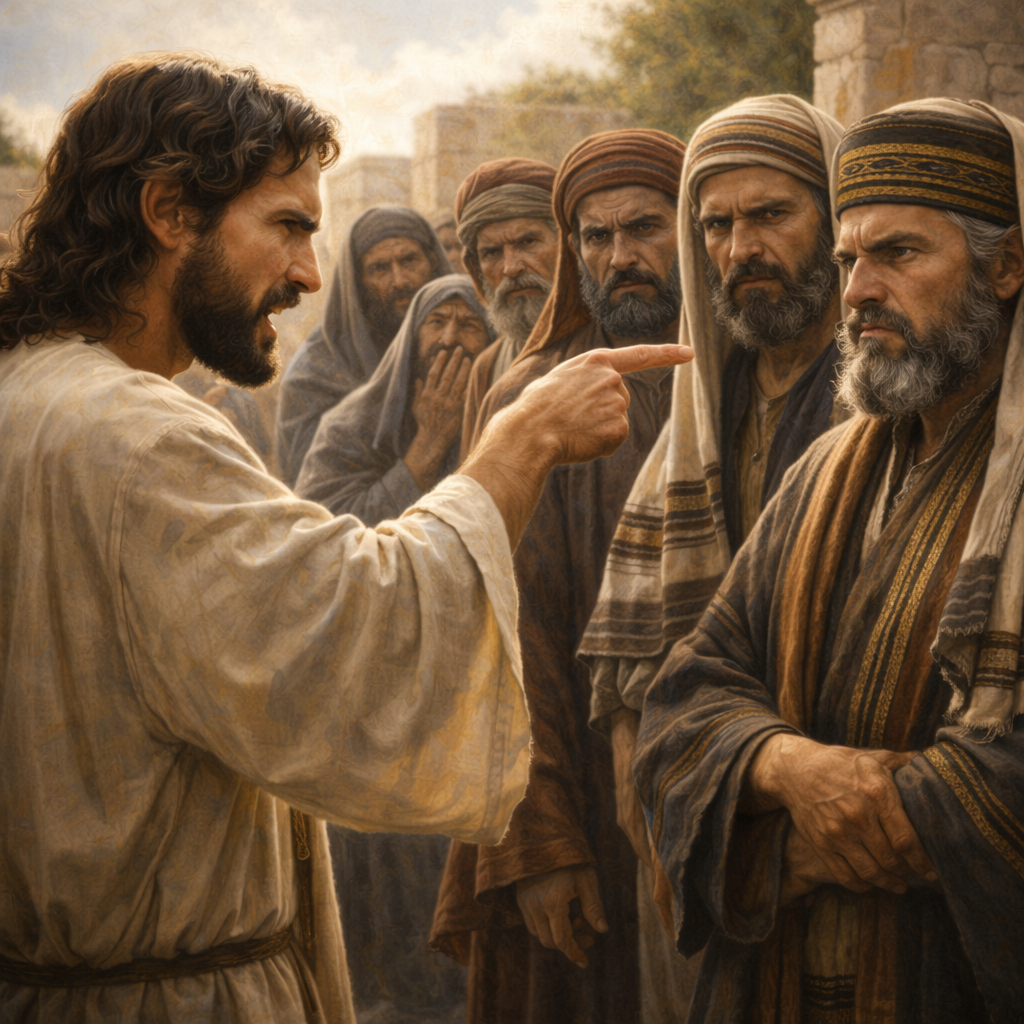
Jesus is turning the whole idea of “what it means to be right with God” on its head. And the religious leaders of the day are not going to go quietly.
You get the idea. This avalanche of condemnation covers many aspects of pharisaical behavior, but a key theme throughout is misplaced judgment about what constitutes righteousness.
I’ll see you next week when we study how Jesus’s claims about who He was aroused rage, jealousy, and violent opposition. Get ready for the fireworks.
— S



Leave a Reply