

(Note: this post, and the related ones to follow in coming weeks, will primarily be of interest to my Christian readership. – S)
Position of Privilege has been quiet for a while, and for good reason: I’ve been working heads-down on an exciting project for the last 1.5+ years, the results of which I’m now releasing for the first time in this post.
I’ve long been fascinated by belief systems and how they’re constituted. On the one hand, a belief system is simply a set of propositions that someone can assert to be true. “In my worldview, X is true, Y is not, and I take no position on Z.” But the reality is more complicated, in part because there are differing degrees of centrality to the beliefs in a system. You might not be equally sure of all those propositions, for one thing. You also might not view them as equally important. I’ll bet that if you thought about it, you’d discover that some of your beliefs you consider indispensable, others supplementary, and others outright fringe.

At university, I remember projecting my nascent Christian theology to a series of concentric circles. The core of this virtual avocado contained beliefs that literally defined the faith, and which if someone disavowed, I’d go so far as to declare them “non-Christian.” (These included things like “there is a God, and only one” and “humankind is inherently sinful” and “Jesus provided a way for salvation.”) Each successive layer outwards contained more peripheral assertions, until the outermost layer represented “things I myself am not even sure about.” (The pre-trib/post-trib eschatological controversy was among the outermost, as were the contemporary speaking of tongues and the “federalist” vs “realist” theories of Adamic guilt.) In between were various layers labeled “things I’m sure of, but which are not necessary to salvation”; “things that define my particular denomination”; “things you must believe to qualify for church leadership”; and so forth.

This was vaguely satisfying. But it begged the question: “how does one decide which beliefs are more central than others?” Some of it is common sense, but it’s maddeningly difficult to pin down a general rule. I couldn’t help but wonder if my choices were arbitrary.
What I wanted was something that would tell me which, of all the myriad doctrines Christians are supposed to accept, were the truly crucial things, and which were more supplementary. I wanted to know, push come to shove, which hill(s) I should die on.
The main thing is to keep the main thing the main thing
It turns out, people are pretty bad at recognizing what’s central. Study after study (beginning perhaps with the pioneering work of Kintsch 1978, and later confirmed by Johnson-Laird 1983, Cain & Oakhill 1999, Best & Rowe 2005, Trabasso & Wiley 2005, Rim et al 2013, Ven der Broek 2014, etc.; see refs at the bottom of this post) has demonstrated that picking out a few specifics from a text or speech is often far easier than grokking what its main point is. Jane Oakhill’s work confirmed that the ability to comprehend individual sentences does not necessarily translate to a good understanding of the passage as a whole. More recently, Aziz et al 2024 identify the ability to separate main ideas from supporting details as one of the hardest academic skills for undergraduates to acquire.
To drive this point home, perform the following thought experiment. imagine giving some high school students a reading comprehension test. Ask them two questions after they read the passage:
- “What specific historical event does this author cite as the turning point for labor unions?”
- “What is the author’s purpose in writing this article on labor unions?”
I’ll bet you dollars to donuts they ace the first question and bomb the second. And the research backs me up on that.


One reason this task is hard may be what Harp and Mayer (1998) termed “the seductive detail effect“: the presence of prominent or interesting details in a passage inevitably causes readers to shout “squirrel!!” and run after them, forgetting most or all of main point of the text.
(Interestingly, the inclusion of such exciting details was originally intended as a strategy to “liven up” boring textbooks, and thereby increase student engagement with the concepts in their reading. It seems to have had the opposite effect.)
Another reason this activity is difficult is that determining an author’s “main point” requires deep processing over a longer length of text than noticing details does. It demands a more sustained cognitive commitment, more robust attention, and an ability to piece multiple threads together. Details are one-offs, and they often stick in the mind with little effort, especially if juicy. This effect is probably exacerbated by modern classrooms that prioritize “procedural engagement” with material at the expense of “substantive engagement.” (Nystrand et al 1989)

Again, a thought experiment. If you’re a churchgoer, imagine the following two scenarios:
- Your pastor delivers a sermon one Sunday which subtly but significantly calls into question a key doctrine of your church’s statement of faith.
- Your pastor delivers a completely uncontroversial sermon, fully supporting all of your church’s official theology. Oh, and he also happens to drop a casual F-bomb somewhere in the middle of it.
Which of the two do you think would generate more animated buzz in the church hallways after? I thought so.
Anyway, no matter the reasons, if “the main thing is to keep the main thing the main thing,” as the proverb goes, we would seem to be in a world of hurt. We often can’t even tell what the main thing is.
Back to the Bible
My point in the previous section is simply that separating the more important from the less important is hard. Most of us are not naturally good at it. And this is frightening when the stakes are high (when, for instance, it involves questions of one’s worldview). It’s too easy to slip into sheer subjectivity: “X seems more important to me than Y, but there’s no way to really resolve that, so I’ll just trust my gut feel.”
Now I’ve been a Christian for going on 39 years, and thus the Bible — and specifically the New Testament (NT) — form the backbone of my worldview. It is the only living record of what the original Apostles taught, and since Jesus Himself never wrote anything down (at least, nothing that has survived) it is our only lifeline to the Master. Therefore, for a disciple of Christ, correctly discerning what in the NT is central versus peripheral is of monumental importance.

Hence my Bible Bar Graph project. I was inspired by the following assumption, which I hope you’ll agree is quite reasonable: the relative importance of a topic is roughly proportional to how often it appears in the source text.
Exactly proportional? No, I wouldn’t go that far. All kinds of rhetorical devices are in play whenever anybody says anything, so I don’t think we can always depend on a precise word-count metric. Still, I think you’ll agree that if someone, say, visited your community to give a talk, and they spent 80% of their time addressing topic X and the other 20% addressing Y, you’d be scratching your head later on if that person told you their “main point” was actually Y. Why would they have droned on so long about X if X wasn’t even central? Whatever their convictions, I think you could safely say they did a poor job of communicating them.
To sum up: the sheer amount of real estate any text devotes to a topic is surely at least a rough proxy for that topic’s importance to the author. And since the most important text for my life and worldview is the New Testament, I decided to apply that principle rigorously to it.
The Bible Bar Graph (BBG) project
I thus embarked upon what became a 21-month project. My quest was to quantify how centrally important various Biblical doctrines really are to the Christian faith. I did this by re-reading the entire New Testament afresh, meticulously categorizing every verse into one or more topics from a growing list. Many of the topics I had already anticipated before even beginning. A few others emerged and coalesced along the way.
Every time I finished a chunk, I reviewed and sanity checked my results. I also sent these periodic updates to a small group of core supporters for their feedback, many of whom are pastors and/or otherwise theologically trained. In only a minuscule number of cases did my findings strike any of them as odd, in which case I re-explored and re-counted things to resolve the apparent discrepancy. And before you ask: yes, I found this whole process fun.
The raw results from this project can be found here. Even though I’m “done,” I still consider it a work in progress, and am happy to accept feedback or criticism. Here are some dashboard stats, for those interested:
- There are 7,957 verses in the NT (this includes all disputed passages such as Mark 16:19-20, John 7:53-8:11, Acts 8:37, etc.)
- It took me 642 days to complete (this averages out to 12.4 verses/day)
- I created 242 distinct topic labels (these are listed alphabetically at the end of this post). The smallest three of them appear in only four verses each (or in about .005% of all NT verses); the largest one appears in 567 (or 7.1% of all verses)
- There are 7,525 entries in my table (many of them for multi-verse passages)
- There are 16,241 verse tags (in other words, there were about 16k verse-tagged-with-tag pairings)
- This computes to about 2.04 tags per verse, on average
Over the months, I restrained myself from looking at any partial totals. I wanted to experience the “big reveal” myself. If you know your Bible, I’ll bet your reaction to the outcome will be similar to mine: a mixture of quantitative confirmation of things you already knew, combined with jaw-dropping surprise at the size of some unexpected categories. Without further ado, let me just plop down the final Bible Bar Graph en toto. The length of each line represents the number of verses tagged with that category. (Scroll down! And click on the image to see detail):

Woof. That’s everything. Not surprisingly, we see a Zipf’s Law-ish distribution in action. If we zoom in on just the top categories (with at least 100 verses each), we see:
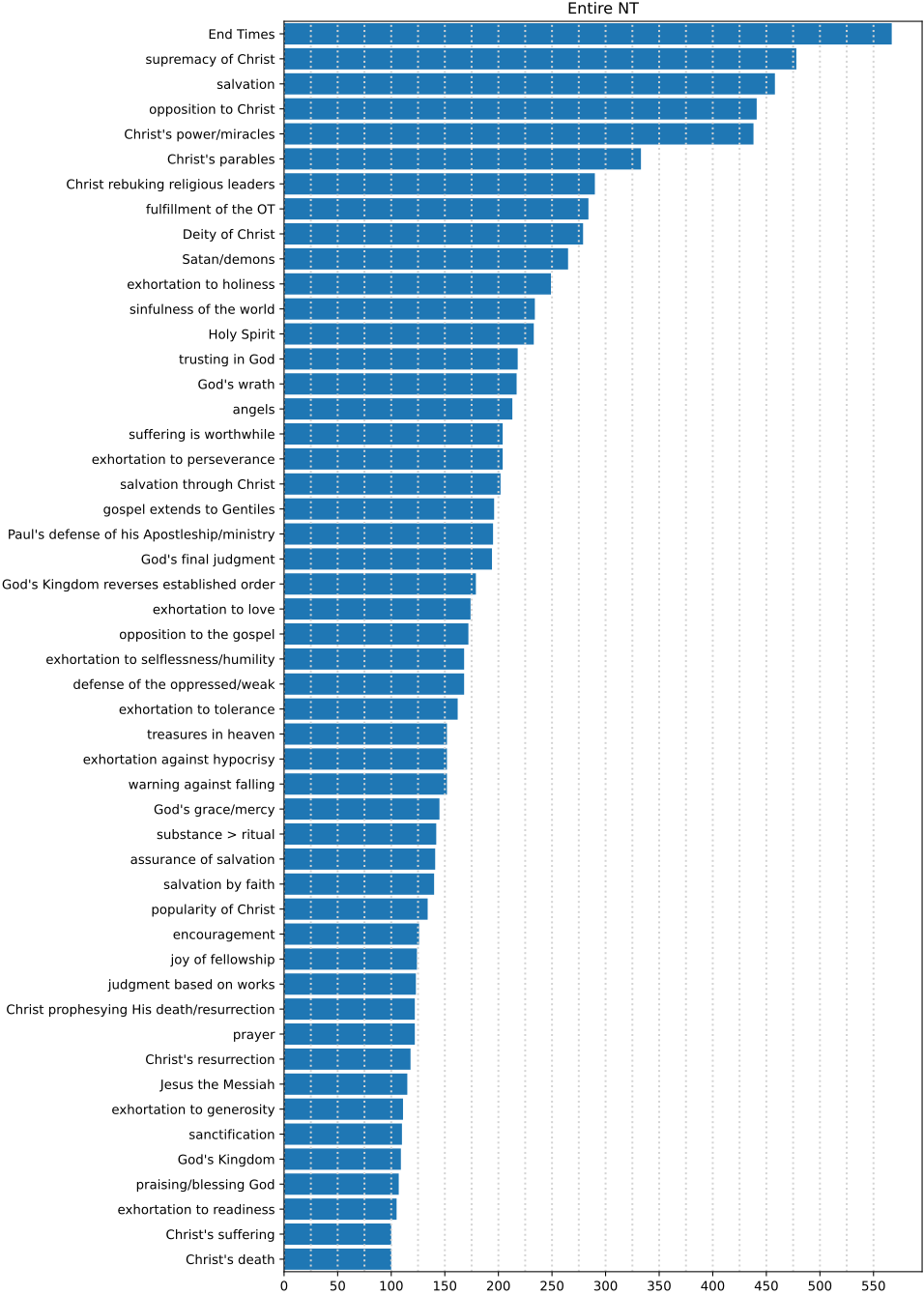
Sneak preview
There’s loads and loads to unpack here. But this introduction has been long enough, and I’ve learned the hard way to try and make my posts bite-sized. Thus I’ll be highlighting various findings in coming weeks on Position of Privilege, including explaining what I intended to capture by some of the categories whose names may not be obvious. Stay tuned. There are many gems hidden in this data that have really opened my eyes.
Before I leave you today, though, I can’t resist commenting briefly on what is the largest category — and the biggest takeaway — of the entire project: End Times. (For the uninitiated, this phrase refers to the (possibly?) distant future: the final fulfillment of God’s plan for the universe, including divine judgment, the resurrection, and Jesus’ prophesied Second Coming.) It towers above all its competitors at a whopping 567 verses.

Perhaps you find this result as stunning as I do. I’m frankly embarrassed by how completely taken aback I was by it. After all, I estimate I’ve read the entire New Testament at least 25 times in my life, and the more significant passages many more times than that; I’ve read it all in the original ancient κοινή Greek, the King James, the English Standard Version, two different New International Versions (the 1984 and 2011 releases), Esperanto, and (currently working on) Chinese. I think it’s fair to say I’m pretty familiar with its contents. Yet I was absolutely dumbfounded to find “End Times” sitting at the top, and by a wide margin.
You see, I had always thought of “eschatology” — the theological subdiscipline which concerns the prophesied final events of this world order — as a relatively fringe Christian topic. Sure, there were different theories about it, some with highfalutin names; sure, there were some memorable Scriptural passages that dealt with it. But on the whole I imagined it as less central, and certainly less frequently discussed in the NT, than topics like soteriology (the study of salvation), christology (the study of Jesus’ nature), hamartiology (the study of sin and its consequences), and so forth. No longer. I stand corrected, and my theological understanding is deservedly a bit shaken.
This fact alone deserves plenty of contemplation which I’ll consider in my next post. But for now I’ll just leave you with this bite of thought-food: this present world really is “all prologue.” We wade in minutiae every day, some of which feels (and some of which actually is) important. But God’s perspective is immeasurably wider and His purposes immeasurably farther-reaching. His plan is eternal, and our present lives are like blades of grass (Isaiah 40:6-8). He has something entirely bigger in store. And if we read His word and come away with only thoughts about this present life, we might need a nudge to lift our eyes to the horizon.
— S

The topics (alphabetical):
- affirmation of professional ministry
- affirmation of singleness
- ancestry of Christ
- angels
- the Antichrist
- Apostles rebuke other people
- Apostles rebuke religious leaders
- Apostles’ miracles
- Apostles’ teaching
- assertion of monotheism
- assurance of God’s presence
- assurance of God’s protection
- assurance of God’s provision
- assurance of salvation
- baptism
- believers as Christ’s representative
- believers as Light
- believers reigning with Christ
- blessings
- blindness of the world
- Body of Christ
- centrality of Christ
- Christ affirming OT commandments
- Christ as Light
- Christ foreknown/foretold
- Christ is truth/word/wisdom
- Christ prophesying His death/resurrection
- Christ prophesying second coming
- Christ rebuking disciples
- Christ rebuking other people
- Christ rebuking religious leaders
- Christ the Creator
- Christ the Life-giver
- Christ the Mediator
- Christ the Sustainer
- Christ’s ascension
- Christ’s compassion
- Christ’s death
- Christ’s heavenly origin
- Christ’s humility
- Christ’s identification with humankind
- Christ’s limitations
- Christ’s love
- Christ’s modesty
- Christ’s parables
- Christ’s post-resurrection appearances
- Christ’s power/miracles
- Christ’s praying
- Christ’s resurrection
- Christ’s suffering
- Christ’s teaching
- Christ’s temptation
- Christ’s wisdom
- Church discipline
- Church’s authority
- circumcision (lit. and fig.)
- contentment
- conviction of sin
- death to sin
- defense of the oppressed/weak
- Deity of Christ
- discipline
- Divine influencing of events
- doing good glorifies God
- election/predestination
- encouragement
- End Times
- eternal life
- exhortation against adultery
- exhortation against anger
- exhortation against complaining
- exhortation against drunkenness
- exhortation against gossip
- exhortation against greed
- exhortation against homosexuality
- exhortation against hypocrisy
- exhortation against idolatry
- exhortation against jealousy
- exhortation against partiality
- exhortation against rash words
- exhortation against retaliation
- exhortation against sexual immorality
- exhortation against sins of the heart
- exhortation against sloth
- exhortation against speculation
- exhortation to discernment
- exhortation to doctrinal correctness
- exhortation to evangelize
- exhortation to expose evil
- exhortation to fear God
- exhortation to forgiveness
- exhortation to generosity
- exhortation to grow in knowledge
- exhortation to holiness
- exhortation to hope
- exhortation to imitate believers
- exhortation to imitate Christ
- exhortation to love
- exhortation to love enemies
- exhortation to maturity
- exhortation to not be ashamed
- exhortation to obedience
- exhortation to obey worldly authorities
- exhortation to orderliness
- exhortation to perseverance
- exhortation to prayer
- exhortation to preparedness
- exhortation to readiness
- exhortation to rebuke others
- exhortation to repentance
- exhortation to rest
- exhortation to self-control
- exhortation to selflessness/humility
- exhortation to service
- exhortation to thankfulness
- exhortation to tolerance
- exhortation to truthfulness
- exhortation to unity
- exhortation to worship
- expansion of the Church
- faith glorifies God
- faith leads to good works
- false Christs
- family of God
- fellowship of believers
- final resurrection
- following Christ brings conflict
- following Christ is costly
- freedom from sin
- freedom from the law
- fulfillment of the OT
- futility of the law
- futility/seductiveness of the world
- gender roles
- general revelation
- glorification of the believer
- God as Light
- God’s calling
- God’s final judgment
- God’s grace/mercy
- God’s holiness
- God’s impartiality
- God’s justice
- God’s Kingdom
- God’s Kingdom reverses established order
- God’s love for believers
- God’s love for Christ
- God’s love for Israel
- God’s patience
- God’s rest
- God’s wisdom
- God’s wrath
- godly pride
- the gospel
- gospel extends to Gentiles
- greater blessings -> higher standards
- greetings
- hell
- the hidden will be revealed
- Holy Spirit
- Holy Spirit as guarantee
- Holy Spirit as mediator
- Holy Spirit inspires prophecy
- Holy Spirit leads
- Holy Spirit teaches
- Holy Spirit’s indwelling
- Holy Spirit’s power
- Holy Spirit’s sanctification
- hope in God
- hope of salvation
- human pride/ambition
- humanity of Christ
- impact of Christ’s resurrection
- inner peace
- Jesus the Messiah
- joy in God
- joy in the law
- joy of fellowship
- joy of salvation
- judgment based on works
- knowledge is important
- limitations of knowledge
- Lord’s Supper
- marriage/divorce
- the Millennium
- miracles authenticate
- the mystery of God
- New Heavens and New Earth
- omnipotence of God
- omniscience of God
- opposition to Christ
- opposition to the gospel
- our identity in Christ
- our weakness highlights God’s strength
- Paul’s defense of his Apostleship/ministry
- Paul’s rebuke of churches
- peace among believers
- peace with God
- popularity of Christ
- praising/blessing God
- prayer
- prayer for earthly events
- prayer for others’ holiness
- primacy of spiritual things
- principles of leadership
- qualifications for church leadership
- the Rapture
- rebuke for worshipping the non-Divine
- reliability of Scripture
- the remnant
- the resurrection body
- Sabbath
- salvation
- salvation by faith
- salvation through Christ
- sanctification
- Satan/demons
- sin corrupted creation
- the sinful nature
- sinfulness of the world
- sinlessness of Christ
- spiritual gifts
- spiritual rebirth
- spiritual warfare
- substance > ritual
- suffering is inevitable
- suffering is real
- suffering is worthwhile
- supremacy of Christ
- temptation of the believer
- testimony of the Apostles
- treasures in heaven
- trusting in God
- tyranny of the sinful nature
- unity with Christ
- victory over death
- victory over Satan
- victory over the world
- the virgin birth
- walking in the Light
- warning against falling
- warning against false teachers
- wisdom of the world vs God’s wisdom
Aladini, A., Jalambo, M., & Abdelkarim, R. (2025). The Effectiveness of Artificial Intelligence Tools in Enhancing Listening Skills among Omani EFL 12th Graders: A Quasi-Experimental Study. Journal of Educational Sciences, 33(1), 1–19.
Aziz, A., Ahmad, T. S. A. B. S., Aziz, R. B. A., Awang, S. B., Ahmad, S. N., & Azlan, N. A. B. (2024). Essential Tools for Developing Critical Reading: A Structured Guide for Undergraduate Students.
Best, R. M., Rowe, M., Ozuru, Y., & McNamara, D. S. (2005). Deep-level comprehension of science texts: The role of the reader and the text. Topics in Language Disorders, 25(1), 65–83.
Cain, K., & Oakhill, J. V. (1999). Inference making ability and its relation to comprehension failure in young children. Reading and Writing, 11(5–6), 489–503.
Duke, N. K., & Pearson, P. D. (2009). Effective Practices for Developing Reading Comprehension. Journal of Education, 189(1–2), 107–122.
Harp, S. F., & Mayer, R. E. (1998). How seductive details do their damage: A theory of cognitive interest in science learning. Journal of Educational Psychology, 90(3), 414.
Johnson-Laird, P. N. (1983). Mental models: Towards a cognitive science of language, inference, and consciousness. Harvard University Press.
Kintsch, W., & Van Dijk, T. A. (1978). Toward a model of text comprehension and production. Psychological Review, 85(5), 363.
Nystrand, M., & Gamoran, A. (1989). Instructional Discourse and Student Engagement.
Oakhill, J. V., & Cain, K. (2012). The Precursors of Reading Ability in Young Readers: Evidence From a Four-Year Longitudinal Study. Scientific Studies of Reading, 16(2), 91–121.
Rim, S., Hansen, J., & Trope, Y. (2013). What happens why? Psychological distance and focusing on causes versus consequences of events. Journal of Personality and Social Psychology, 104(3), 457.
Trabasso, T., & Wiley, J. (2005). Goal Plans of Action and Inferences During Comprehension of Narratives. Discourse Processes, 39(2–3), 129–164.
Van den Broek, P., Virtue, S., Everson, M. G., Tzeng, Y., & Sung, Y. (2014). Comprehension and memory of science texts: Inferential processes and the construction of a mental representation. In The psychology of science text comprehension (pp. 131–154). Routledge.
Wade, S. E. (2014). How interest affects learning from text. In The role of interest in learning and development (pp. 255–277). Psychology Press.

Leave a Reply